
Your website has been paid for twice, first on the invoice from whoever designed it three years ago and then, every month since, on the one from whoever is supposed to get Google to notice it exists, and those two people have never spoken. Nobody flagged that as strange, which is the problem, because web design and SEO get sold to small business owners as two separate jobs when they're one job wearing two invoices. [hand raised] I build both under one roof and still catch myself thinking of them as separate skills, right up until I watch a gorgeous site sit on page four of Google, which is where beautiful websites go to be ignored. Here's what happens once you stop treating them like strangers.
1. Why Web Design and SEO Services Keep Getting Sold as Two Different Jobs
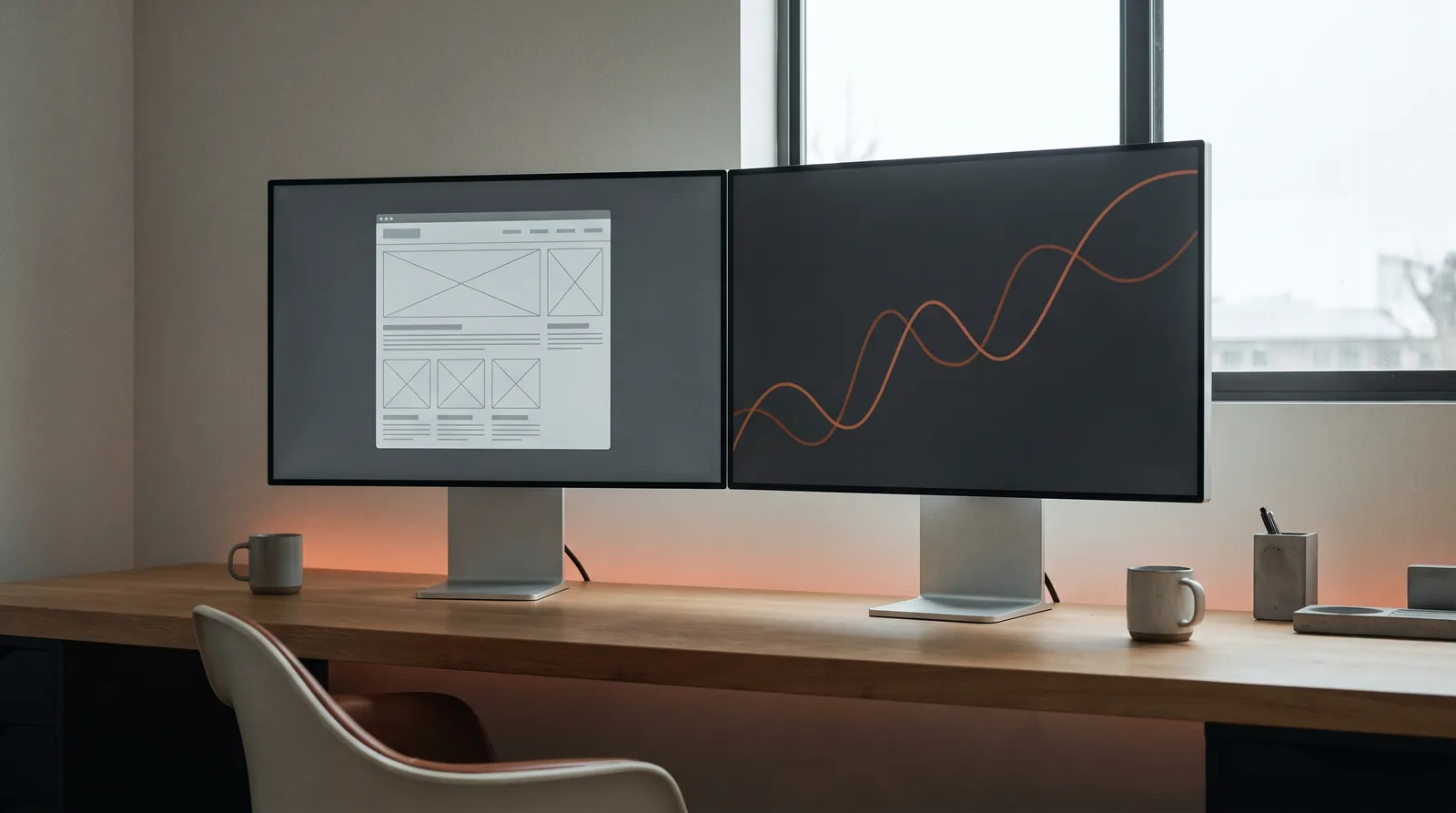
Type "seo for web designers" into Google and you'll find thousands of working designers trying to retrofit search knowledge onto a portfolio they already shipped, which tells you where the split really comes from. It is baked into how the two disciplines got taught, hired and priced from the start. Design school covers typography and grid systems. Marketing courses cover keywords and backlinks. Nobody sits the two rooms down together, so most small businesses end up hiring a designer who makes the site look sharp, then a separate SEO person who arrives afterward to explain, gently, that the sharp-looking site has no headings a search engine can parse.
That handoff is where things go wrong, because a site's structure gets decided at the design stage, not fixed later. Once a homepage ships with images uncompressed, headings used for size instead of hierarchy, and half the copy locked inside one long banner image, an SEO person arriving in month two is stuck optimizing a building whose foundation is already poured. A Carleton University study put the time it takes people to judge a website at about 50 milliseconds, and the structure behind that first glance is the same structure Google reads when it decides whether the page deserves a ranking at all.
2. SEO-Friendly Web Design Starts on the Phone Screen
Every decision that makes a site fast and easy to use is, from Google's side of the desk, also a ranking decision, because page speed and mobile usability are signals the algorithm reads directly off your build. A slow homepage doesn't just annoy the person staring at a spinning wheel. It tells Google, in real time, that your site is a worse answer than the next one down the results page, and the algorithm has no patience for waiting around to find out you're great once it finally loads.
63% of web traffic comes from mobile, and for a small business site that share tends to run even higher, since most people are searching from a parking lot or a couch rather than a desk. According to Google Search Central, Google uses the mobile version of your site to set your ranking for everyone, including the person searching from a laptop, so a homepage that only looks finished on a 27-inch monitor is quietly losing ground it never gets a chance to defend.
Every template builder advertises itself as mobile-friendly, and in the narrow sense that the layout shrinks to fit, it is. Shrinking isn't the same as rethinking a booking form for someone typing with one thumb while holding a coffee, or deciding which three things on a cluttered desktop layout deserve to survive the jump to a five-inch screen. That's a design decision with an SEO consequence attached, which is the whole argument of this post, said once more so it sticks.
3. What a Local SEO Audit Finds That a Redesign Should Have Caught
Trust gets built visually before a single word gets read, and for a local business that trust is doing double duty: convincing a stranger you're legitimate, and convincing Google that your address, hours, and services match your Google Business Profile. When those two stories disagree, a customer notices the small mismatch and a search engine notices it too. Neither one tells you why they left.
Run an honest local SEO audit on almost any small business site and half of what turns up shouldn't be an audit finding at all. It should have been caught at the design stage: no schema markup identifying the business type, a phone number formatted three different ways across three pages, a contact page listing an address the Google Business Profile doesn't match. (I have seen a law firm's own footer disagree with its own homepage about which floor the office is on.) A site built with SEO in mind from day one produces almost none of that mess, because the person building it was checking as they went instead of discovering it eighteen months later in a spreadsheet.

4. Same Street, Same Work, Different Results
Take two businesses on the same street doing the same work, one with the better reviews and one with the faster site. The stranger searching from a phone lands on the fast site, finds the phone number without scrolling and books, so the better business loses the job by about four seconds without ever knowing it was in the running. Four seconds sounds small until you remember that's roughly the entire window most people give a page before deciding whether to stay or bounce back to the results.
The fix wasn't a rebrand or a new logo. It was rebuilding the path between someone typing a search into their phone and a form that gets filled out, with the design and the SEO decided together instead of in sequence. You can browse the builds and judge for yourself whether design and search look like one decision.
5. What AI Answers Look For Before They Name a Business
People are increasingly asking ChatGPT, Perplexity, and Google's AI Overviews to just tell them who to call, instead of clicking through five sites to compare. Those tools pull their answer from whichever site is structured clearly enough to summarize in one breath, which quietly rewards the exact same things a strong local SEO practice already asked for: a plainly stated service list, a real address, and content that says what you do without making a reader hunt for it.
This is where schema markup stops being a nice-to-have and starts being the thing that decides whether an AI answer mentions you at all. Most of the benefits of local SEO that used to show up only as a better spot on the map are now feeding these AI answers directly too, so a small business that already invested in getting its local presence right is sitting on an advantage it didn't know it was building for this.

Small Business Website: Template Builder vs. Custom Design
Count design and SEO as one project instead of two and the options line up like this.
| Feature | Template Builder (Wix, Squarespace) | Custom Design |
|---|---|---|
| Upfront cost | Low ($20–$60/month) | Higher (one-time project fee) |
| Mobile performance | Basic | Fully optimized |
| SEO capability | Limited | Full control |
| Unique to your brand | No | Yes |
| Load speed | Average | Optimized |
| Scales with your business | Limited | Yes |
| Long-term ROI | Lower | Higher |
A template can get you online by Friday. It rarely gets you found, which is the gap our web design services are built to close from day one.
What Every Small Business Website Needs for Design and SEO
Here's the short version of what should already be true before a single visitor shows up:
- A clear headline above the fold stating what you do and who you serve, before anyone has to scroll to find out
- Schema markup identifying your business type, address, and hours the same way everywhere they appear
- Real photography of your actual work or space, not stock photography a competitor down the street is also using
- Mobile-first navigation built for a thumb, not a mouse
- Page speed under 2.5 seconds on mobile, checked free at PageSpeed Insights
- On-page basics done at launch: title tags, meta descriptions, a real heading structure, and alt text on every image
Frequently Asked Questions
How do web design and SEO work together?
They work together because they're deciding the same things from two different angles: how fast a page loads, how clearly it's structured, and how easily a stranger can find what they need. A site designed without SEO in mind usually looks fine and ranks nowhere. An SEO plan bolted onto bad design usually ranks for a few months and then converts nobody, because the traffic arrives and leaves within seconds.
Does web design affect SEO for a small business?
Yes, directly, through page speed, mobile usability, site structure, and how long a visitor stays once they land. A small business site that's slow or confusing on a phone underperforms in search no matter how good the writing on it is, because Google is measuring what real visitors do on the page, not just what the page says about itself.
What makes a good small business website for both design and SEO?
A good one loads in under three seconds on a phone, says clearly what you do on the first screen a visitor sees, and carries basic schema markup identifying your business without anyone having to ask nicely. Real photography beats stock every time, not because stock photography looks bad, but because a stranger can usually tell the difference between a business that exists and one borrowing a photo of somewhere else's storefront.
Why is mobile design important for web design and SEO?
Because Google ranks your site using the mobile version of it, not the desktop one, and because most people deciding whether to hire you are doing that deciding from a phone. A booking form you have to zoom into on a phone loses the ranking and the customer together, which is an expensive way to save five minutes of design work.
How much does web design and SEO cost for a small business?
A professionally built small business site usually runs a few thousand dollars upfront, with ongoing SEO work priced separately depending on how competitive your market is. A template is cheaper in the first month and tends to lose that lead by the second year, mostly through visitors who gave up before the page loaded. For a number built around your own site, reach out here.
The Bottom Line
Underneath all the design choices, a small business website has one job: take a stranger who found you by accident and get them calling, booking, or buying before they lose interest and click back to the results page. Design earns the click. SEO earns the chance to be seen at all. Split the two across different invoices and you're paying twice for a job that only works when it's done once.
The question was never whether design and SEO matter. It's whether the site you have right now treats them as one decision or two, and whether anyone involved in building it has looked at both invoices side by side. (I've looked at a lot of them. The two rarely agree on what year it currently is.) If you're not sure which one describes your site, let's find out.